


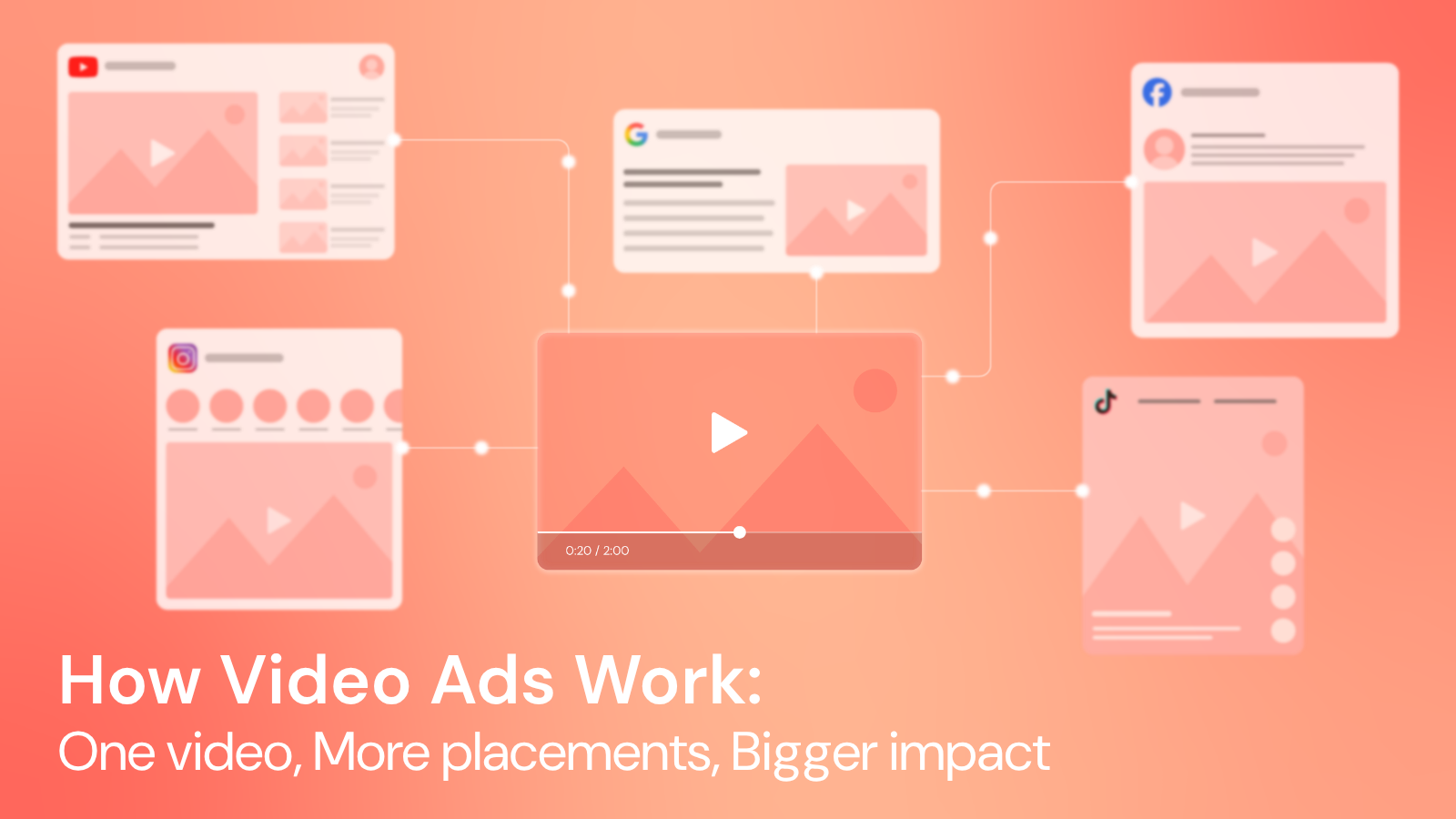
Today your feed looks completely different than it did five years ago. Open Instagram, TikTok or YouTube and you’ll likely find people talking and products being demonstrated almost immediately. Static images are still an important part of advertising, but video has become an increasingly familiar way for people to consume information online.
For businesses, this shift matters. Yet for many, particularly for SMBs, video advertising can still feel complex to understand, create and use effectively. What exactly makes a video ad different from a static ad? How does it work? And, perhaps most importantly, why should businesses be thinking about video now?
This blogpost breaks down the fundamentals of video advertising, from how video ads work to what makes them effective, while looking at why video has become an increasingly important part of advertising performance.
From a static message to something people can see, hear and feel
At its simplest, a video ad is an advertising format that uses video, sound, captions and movement to capture someone's attention. Unlike a static ad, which relies primarily on an image and text, video gives businesses multiple ways to communicate their message at once, creating more opportunities to engage with their audience.
A static ad might communicate what a business offers through an image and a few words. However a video ad can show the product or service, introduce a problem, explain a solution, use sound and captions to reinforce an idea, and create an opening line designed specifically to capture attention.
In other words, video doesn't necessarily change what an ad is trying to achieve, it changes how the message is delivered.
This is particularly relevant in an environment where people increasingly consume information through video, especially short-form content. Video gives businesses another way to communicate in a format audiences are already accustomed to consuming.
Turning a Video Into an Ad: How It All Comes Together
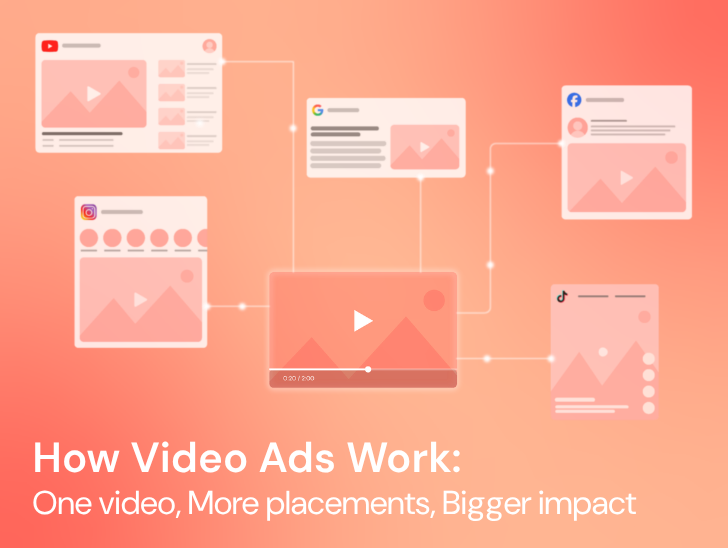
Mechanically, video ads run the same way static ads do. A business can create or provide a video, upload it to the relevant advertising network and submit the ad. The network then delivers that creative through its available video ad placements.
The main differences happen with the creative itself and the metrics that can be measured.
Rather than being limited to a single visual and text, video allows the message to unfold through a combination of motion, audio and on-screen elements.
It also gives businesses a deeper view of how audiences engage with their content. A static ad gives you signals such as clicks and impressions, while video can provide additional insights into how long people actually watched. Someone who watches a video for five or ten seconds is showing a different level of engagement from someone who scrolls past almost immediately.
These viewing signals can help indicate which users were more interested in the content and, in some advertising approaches, can support remarketing for those who watched for longer. It’s another reason why the initial hook of a video matters so much, the stronger the opening, more reasons people have to keep watching.
More ways to capture your audience’s attention
For SMBs, in particular, video can make a product or service easier to understand and more memorable. Something that may be difficult to explain through an image and a few lines of text can be demonstrated more clearly through video, giving audiences something they can see and hear rather than simply read.
But the importance of video goes beyond what businesses can communicate. The way audiences consume information is changing. Short-form video has become an increasingly familiar part of how people engage with content, making it an important format for businesses that want to stay relevant and keep pace with their competitors.
Before they scroll, give them a reason to stay
The first three to five seconds can determine whether someone keeps watching or moves on to the next video, making the opening hook of the most important parts of a video ad.
A useful starting point is to make the value immediately clear:
You have this problem. We have the solution.
This problem-and-solution approach is one of the most popular and effective formats. Other common ad approaches that work particularly well include testimonials and videos that combine written reviews on screen with someone talking about them.
The principle behind all of these approaches is the same: don't make people wait for the point. Every sentence should add value, and the message should remain clear, direct and relevant. If an audience has to wait several seconds before understanding what the video is about, there is a greater chance they will move on before the message gets there.
One message, different ways to deliver it
A video that works on one network may not work the same way on another. The pace, style and opening should reflect the platform, the audience and what the business is trying to communicate. For example, TikTok tends to favour faster, more organic content with an immediate hook, while Google allows a little more time to showcase a product or service.
Before creating a video ad, you should start with a few basic questions:
- Who are we trying to reach?
- What problem does the business solve?
- What does the audience need to understand?
- Which network will the video run on?
There is no one-size-fits-all formula, either. Different services, locations, demographics and verticals can respond differently to the same approach, which is why testing different formats and messages can help identify what works best for a particular audience.
A Few Rules Make a Big Difference
Creating an effective video does not have to mean making it complicated. There are a few principles that apply across networks, before the creative approach is adapted to where the video will appear:
- Hook immediately: give people a reason to keep watching from the first frame.
- Keep it clear: use captions and make sure the message works even without sound.
- Focus on one idea: avoid trying to communicate too many benefits in one video.
Another key difference is adapting the content to each network. Since every platform has its own audience, format, and way of consuming content, the same video approach won’t work everywhere. Here are some key tips to make your creative work effectively on each one.
TikTok
On TikTok, content should feel native to the platform rather than like a traditional TV advertisement. Keep the hook fast (1–2 seconds), use frequent movement and cuts, and prioritise an organic UGC or creator-led style, even simple formats, such as someone speaking directly into a microphone, can work well.
Be mindful of music licensing, use only licensed music for paid content, as trending TikTok sounds may not be cleared for advertising. It’s also important to refresh content every 7–10 days to prevent creative fatigue and maintain long-term engagement.
Meta
On Meta, creative needs to adapt to different placements, with a strong three second hook and the offer appearing on screen within the first 5 seconds. Use the right formats (4:5 for Feed and 9:16 for Reels and Stories) and focus on creating genuinely different concepts rather than repeating the same idea. For cold audiences, keep videos around 15 seconds or less, and refresh content every 2–3 weeks to maintain performance.
YouTube
On YouTube, the first five seconds are critical, so the brand and main message should appear early rather than being saved for the end. Keep action-focused videos around 15–30 seconds, while longer videos can work well when you need more time to explain the product or build interest.
Treat Shorts as a separate, vertical-first format, and use different aspect ratios to maximise placement opportunities. Also keep in mind to refresh content every 4 to 8 weeks, as creative fatigue tends to build more slowly on YouTube.
The takeaway for every network is simple: traditional TV-style advertising, with highly edited and overly polished videos, doesn’t always work. The key is to make the right message clear and engaging, quickly and in a format that fits where people are watching.
A good video starts when you know who you’re talking to
Before thinking about the video itself, businesses need to understand the person on the other side of the screen.
A video should reflect the problem the business is solving and the audience it wants to reach. A message aimed at a younger audience may need a different approach from one aimed at an older audience. Similarly, what resonates in one location may not necessarily resonate with another. This makes audience understanding just as important for video as it is for other forms of advertising.
The creative format may have changed, but the fundamental question remains:
What does this audience need to hear, and what is the clearest way to show them that we can solve their problem?
Why isn't everyone using video already?
If video can offer more ways to communicate and engage, why do many businesses still rely primarily on static ads?
For many businesses, the answer is simple: resources.
Creating video takes more time, expertise and often more investment than creating a static image. SMBs may not have a creative or marketing team, someone comfortable on camera, or the skills to produce and edit video.
As a result, static advertising can remain the easier and more accessible option. The main challenge for many businesses is not understanding the value of video, but having the time, resources and budget to produce it consistently.
Where Leadzai fits into the picture
Video ads are available across Meta, TikTok and Google PMax within Leadzai's advertising platform, with the requirements varying by network. For Google PMax, for example, partners currently provide an unlisted YouTube video URL through the platform, and then an ad can be generated.
Today, static creative still represents a larger share of the ads running on the platform. But as video becomes progressively more important and appealing, the opportunity is not simply to replace static advertising with video. It is to think video-first when considering how a business can communicate its message and reach its audience.
The takeaway: the same message, with more room to land
So, why should businesses be thinking about video ads now?
Because video gives a business more ways to be understood. Movement, sound, captions and a face on screen carry things an image and a headline cannot: how a service actually works, what a problem feels like, why this particular business is worth trusting. For an SMB, that last part matters most. What a small business offers is often personal, and video is what turns an ad that states what they do into one that shows it.
Video also reaches further. A single recording can be cut into different lengths and formats, opening up placements a static image cannot enter, and it tells you more about who paid attention: not just who clicked, but who stayed. Quality matters here — clear sound, good light, a message that lands in the first seconds — but quality is not the same as budget.
For partners, this is the point worth carrying into client conversations. Video is not a different kind of advertising, and it does not ask a business to say something new. It is the same message, delivered in the format audiences are already watching, with more room to make it land.


.jpg)