


How Do Budget Pacing and Rollover Control Work in Digital Advertising?
Pacing in Digital Advertising
Pacing refers to the rate at which a budget is consumed over a defined campaign period (e.g., a month). The objective is not simply to spend the budget, but to spend it optimally in order to hit the campaign’s KPIs.
What Is Budget Pacing and Why Does It Matter?
Pacing ensures that ad spend is proportional to the campaign’s duration, preventing two major pitfalls:
- Overspending early (“burnout”): exhausting the budget too quickly, causing ads to disappear mid-period and missing later conversion opportunities.
- Underspending (“missed opportunity”): failing to deploy budget when demand exists, leaving revenue unrealized.
Common pacing strategies include:
- Even pacing: distributing budget consistently across the campaign period.
- Front-loaded pacing: spending more aggressively early to build momentum or hedge against later price increases.
However, pacing alone does not determine whether spending should happen under current market conditions. That is where rollover control becomes critical.
What Is Rollover Control in Ad Campaign Management?
Most ad platforms allow some degree of daily over- or under-delivery. But in most cases, this is designed to ensure the budget is still fully exhausted within a fixed time window.
At Leadzai, rollover control is managed daily but guided by a different philosophy.
Rollover allows:
- Under-delivery on quiet or inefficient days to be compensated on stronger days
- Over-delivery when performance signals justify it
- Continuous alignment with overall budget limits and campaign targets
This daily rollover logic introduces flexibility without sacrificing control. Spend can adapt to real-time auction dynamics, competition, and demand — instead of being constrained by rigid daily caps.
More importantly, rollover is not only a pacing mechanism. It is a value-preservation mechanism.
Where many platforms optimize primarily for budget exhaustion, Leadzai’s approach optimizes for economic efficiency:
- Avoid forcing spend when CPCs are inflated
- Avoid spending when user intent is weak
- Hold back budget when conversion probability is low
- Redeploy budget when performance conditions improve
In this model, not spending on a given day is not a failure — it is often a sign of disciplined optimization.
Why Do Weekends Expose the Limits of Standard Budget Pacing?
One of the most common (and costly) real-world pacing issues happens every month: weekend inefficiency.
Across many verticals, weekends tend to produce:
- lower search volume
- fewer clicks
- higher CPCs due to auction volatility
- weaker conversion intent
This naturally creates a performance dip. Without rollover control, campaigns often have two bad outcomes:
- They keep spending aggressively despite poor efficiency, increasing CPA/CPL
- They reduce spend but permanently lose delivery volume and fall behind pacing
With Leadzai’s daily rollover control, the behavior is more intelligent.
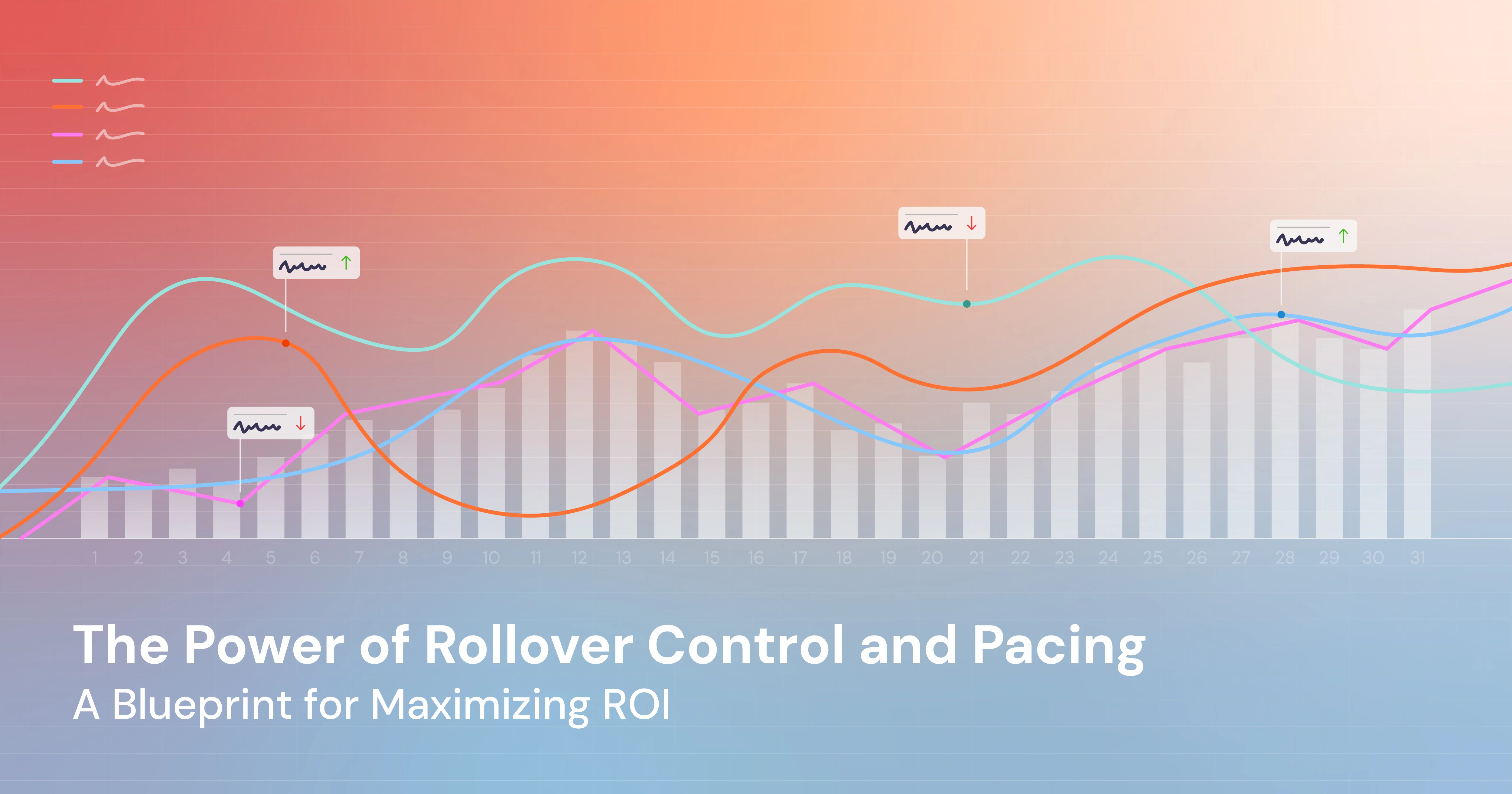
In practice, campaigns can naturally slow down over the weekend — for example delivering only 60–70% of their daily budget fulfillment — and then return to above 100% during stronger weekdays to burn the rollover accumulated over the weekend.
This approach allows campaigns to:
- preserve budget during inefficient days
- reallocate spend into higher-intent periods
- maintain stronger performance and more competitive pricing over the month
- increase total results without increasing total investment
How Is Rollover Controlled to Prevent Overspend?
A key misconception about rollover is that it is a mechanism that “builds up” indefinitely.
At Leadzai, rollover is explicitly controlled. For example:
- A campaign does not accumulate rollover for more than one month in a row
- Rollover is typically small by design — it does not represent runaway underspending
- In general, rollover represents less than 2% of total investment, and is present in fewer than 5% of campaigns
This is important: the value of rollover is not in creating large budget carryovers, but in enabling small, high-impact shifts that protect efficiency and increase results at the margin — especially in periods of low intent or inflated auction costs.
Why Does Rollover Control Outperform Ad Scheduling?
Ad scheduling is often used to restrict campaigns to specific hours or days. While useful for operational control, scheduling answers only one question:
When are ads allowed to run?
It does not answer:
Should we be spending at all right now?
Even with strict schedules, most platforms will still push to exhaust the available budget inside the permitted windows — regardless of auction prices, intent, or performance quality.
Rollover operates at a higher strategic level:
- Scheduling controls time
- Rollover controls value
If demand is weak, prices are inflated, or performance drops, rollover allows budget to be held back and carried forward, instead of being diluted into low-quality traffic.
This distinction is crucial for long-term ROI.
How Do Pacing and Rollover Control Directly Impact ROI?
The combined use of pacing and rollover control directly determines advertising profitability.
1) Smarter Timing of Ad Delivery
Pacing aligns budgets with periods of higher conversion probability.
Rollover strengthens this by ensuring budget remains available for those high-value moments, instead of being prematurely consumed during inefficient periods.
2) Risk Mitigation and Financial Predictability
Controlled pacing smooths spending curves and avoids sudden depletion.
Rollover adds protection: budget that cannot be efficiently deployed today remains available tomorrow.
3) Continuous Optimization and Capital Reallocation
When campaigns pace ahead but fail to deliver results, rollover enables early intervention:
- bids can be reduced
- keywords paused
- budget shifted to stronger segments
This reallocates capital from low-return activity to higher-return opportunities, improving ROAS while reducing waste.
4) Capitalizing on Seasonality and Market Dynamics
Effective budget control must account for demand cycles.
Consider a jet ski rental business:
- demand peaks in summer
- winter searches are scarce and rarely convert
- forcing spend in winter inflates CPCs with minimal return
With daily rollover, budget naturally accumulates during low-demand periods and becomes available when customer intent peaks.
The result:
- lower acquisition costs
- higher conversion rates
- stronger revenue impact from the same total investment
Leadzai as Your Obvious Choice
The evolution of Search and Social advertising requires a shift from passive budget consumption to active budget stewardship.
Pacing ensures consistency.
Rollover ensures intelligence.
Together, they transform advertising budgets from a fixed monthly expense into a dynamic investment asset — one that adapts to market conditions, preserves value during inefficiencies, and deploys capital when it can generate the highest return.
However, achieving this level of control consistently is extremely difficult to execute manually, especially across multiple networks. True pacing and rollover optimization requires daily decisioning, unified reporting, cross-channel visibility, and automation that can react in real time without sacrificing budget discipline or delivery targets.
That is exactly what Leadzai was built for.
Leadzai is an AI-driven cross-channel advertising platform that unifies pacing, rollover control, budget allocation, reporting, and optimization across Google, Meta, and Microsoft — maximizing ROI by investing budgets where they drive measurable impact. Less manual work, stronger predictability, and higher profitability by design.


.jpg)