Laptop Lou
- 1-person, solo show — they're the CEO, Marketing Director & janitor
- Low-cost options valued, as every penny is their own
- Service provider; can work globally with very few overheads



.jpg)

Small to medium-sized businesses (SMBs) are the local heroes of our global economy, representing 99% of all businesses1. These individuals are characterised by their courage, tenacity and a relentless drive to turn their dreams into reality. Beyond their economic impact to GDP and employment, they also serve as the pillars of their local communities, embodying their brands through personal connections and local engagement.
However, the path of the local hero is fraught with challenges. With over half failing within their first three years3, surviving the initial set-up and global disruptions requires a unique mindset. This white paper explores the current pressures, mindset, and evolving feelings of SMBs in 2026 toward digital marketing and Artificial Intelligence. By understanding the three distinct personas covered, industry leaders can better support these businesses with the tools they need to flourish in an increasingly complex digital landscape.
When you look at the definition of ‘hero’ it says, ‘a person admired for their courage, achievements or noble qualities’. SMBs are self-believers and self-starters by their very nature. Compared to most people who are too scared they might fail to even start. SMBs are risk-takers who get up at the crack of dawn to make their dream happen, daily. They’re brave, tenacious & financially ambitious business leaders.
As well as wanting freedom, SMBs passionately care about what they do. As the saying goes, find something you love and you’ll never ‘work’ a day in your life. They are often a pillar within their local community whether it’s being in the pub at 4pm on a Friday and everyone knows the local trades chap at the bar in dusty workwear. Or it’s the impact they make driving networking groups, exercise classes or supporting local schools and colleges they’re known for. Think of a hairdresser, she knows everything about the clients who come to see her from who is about to get a divorce, where people are going on holiday this year within a 5-mile radius of her salon right through to the gossip happening within a town.
For micro businesses (under 10 employees) their name, face, smile is their brand - so reviews are personal and they’ll wear their logo with absolute pride on their work clothes, in essence they are their brand, and they embody it to become walking signage. Finally, SMBs keep the economy alive, they represent 99% of all businesses and account for >50% of all employment worldwide1.
There are three main segments of SMBs, to help bring them to life, below are personas with their unique traits and challenges:


Over time and with different growth strategies, these personas can evolve. Laptop Lou can grow into Dan, who can in turn become a Mike.
Note that over 50% of all businesses will fail within 3 years of opening3. If you’re looking to improve your retention rate, aim to move up the food chain to those who have higher budgets, who understand that Marketing is an investment, not a cost, and have managed to stay afloat for more than 4 years + e.g. aim for Mike.
Within our survey 56% had been in business for over 11 years, meaning they’ve survived not just the initial set-up tribulations that all face, but have made it through a global pandemic too!
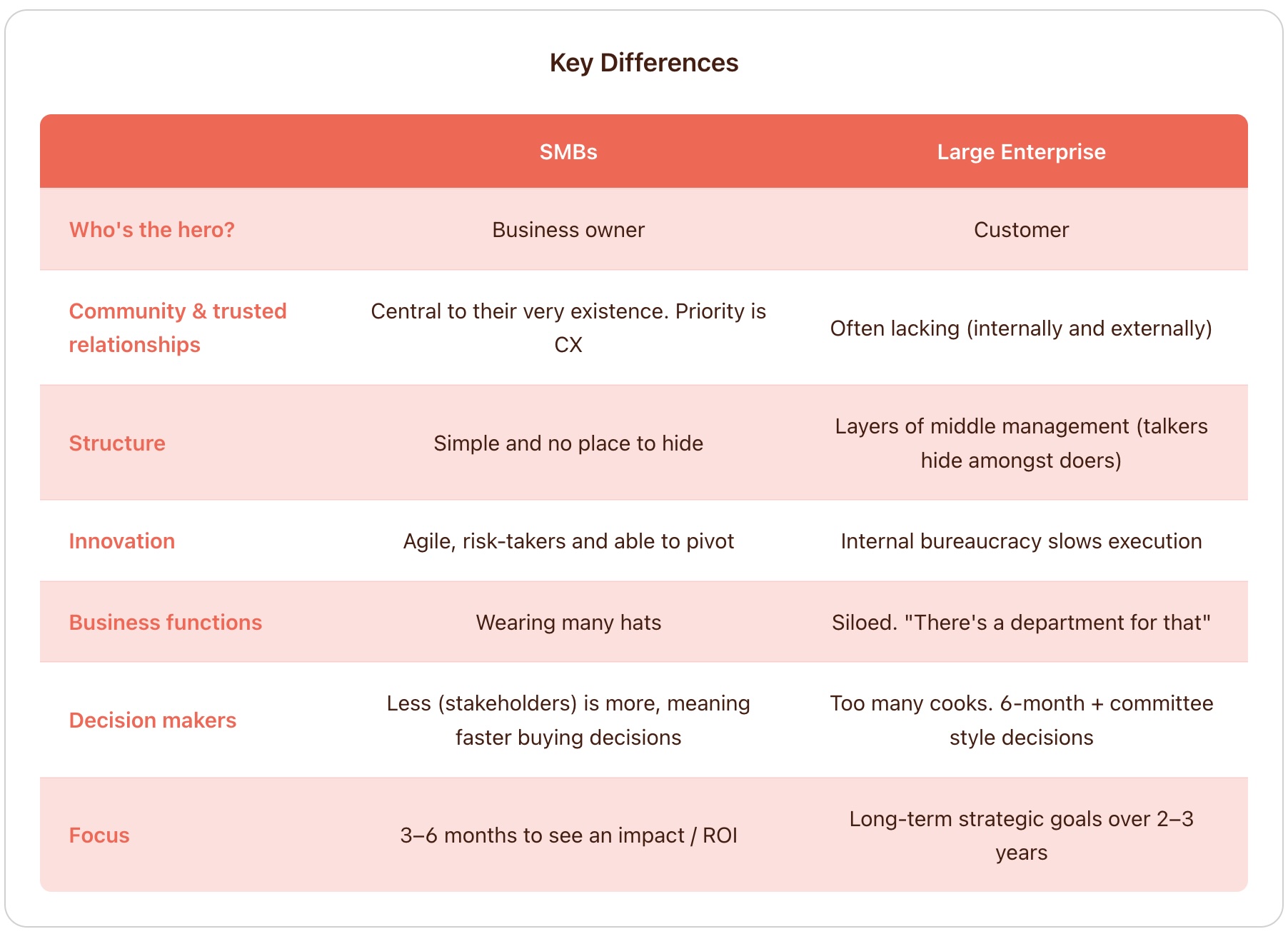
To highlight the unique mindset and differences in approach, the below table compares the SMB to large scale enterprise level businesses.
In April 2026, we surveyed live business owners and SMB leaders to understand their current challenges and pressures, including their thoughts and feelings towards AI and Digital Marketing.
The future’s bright - When we look at other research papers we can see a positive sentiment: 81% optimism level in 2026 about their business’ future and 70% are looking to grow this year, using larger sample sizes.4
A simple to understand Do-it-for-me (DIFM) offering is wanted, as they are already wearing too many hats! Especially for the micro-SMB who is the CEO, Sales Director, tech dept and janitor all at the same time. They are passionate about their business area of specialism but are not typically Marketing experts, nor do they want to be.
Key tip for sellers: don't bamboozle them into boredom to attempt to show your credentials, you’ll end up having a tumbleweed conversation. Think about it if I pick an accountant for my business: I don’t need them to explain the intricacies of VAT legislation to me or the latest digital tax rules, I just want to have the pain removed for me (for a fee) and know I’m not going to get a fine for a late tax submission. Same is true in Digital Marketing – the builder wants to build walls, not websites!
We saw an 80/20 split between Word-of-Mouth versus Marketing efforts2 as the source of new customers for SMBs. Yet sourcing new customers was cited as their number one challenge (34%) as a business owner.2 When we dive into their challenges from a Marketing standpoint the two biggest bottlenecks were content creation (normally bottom of a to-do list after invoicing and payroll is done) and audience engagement to convert surfers into actual sales revenue.2
Human connection will always matter more to SMBs, especially within micro, service-led local businesses. First and foremost, people buy from people, so this will always remain paramount to the SMB owner. They are interested in using AI as a daily utility tool but are using it for basic tasks such as social content creation, communications, and sales and marketing efforts. This is particularly true of the more mundane perceived tasks. This is a combination of lack of trust in AI tools and a lack of first-hand experience on how to prompt well. 68% will extensively test AI before letting it run autonomously4. The SMBs preference is a co-pilot approach to AI, especially for heavy lift administrative tasks. The business owner still provides the tone of voice, brand, strategy and final judgement.
Those who have adopted AI within their business already report efficiency gains5 and are more likely to be growing versus their competition. Growing SMBs are 1.8x more likely to invest in AI than declining SMBs5. In a separate study, 91% of SMBs reported utilizing at least one form of automation to run their business.4 Some are creating augmented workers to drive their productivity, with the smart ones first assessing where processes consume the most time and how automation and AI can drive efficiency.6 Furthermore, as customers’ expectations increase YoY, the ability to use personalized automations through items such as 24/7 support, continuous communication paths and frictionless buying experiences can support the SMBs customer retention and help to improve satisfaction rates.6
The rate of embedded AI adoption increases through the size, tenure and sophistication of the organization, so of our personas above, Merchant Mike would be looking at autonomous admin options, reconciliation agents, and basic CS support to reduce or redirect headcount accordingly.7 Once in place, the SMB requires organizational AI literacy to be able to manage the tools they embed. This is where there is an obvious skills gap.
39% of businesses surveyed were ‘enthusiastic’ about AI, seeing it as a competitive advantage.2 However, what this reveals is that 61% were either skeptical and slightly anxious that AI will replace the human touch that customers value or simply don’t understand where it can be leveraged within their company.
Imagine a landscaper: AI isn’t going to cut the grass for him, but it could write a social post for him better than he could do himself.
The most important step when adopting automation or AI is that the SMB has clarity over their direction before scaling its use. For example; if your CRM and data lake is a mess, tackle that first before considering “AI is the solution”. This will avoid strategic drift and wasted time and resources. Quality input leads to quality output (and the reverse is also true).
As industry leaders representing AdTech, CRM and Digital Marketing solutions, we have a duty to support these self proclaimed, time-poor SMBs who need an all-in-one, DIFM service for their Marketing needs. While they need a website, social presence, and paid ads, they don’t want separate contacts and different specialists where possible, they want one company that can provide them with a full-service solution and a single point-of-contact. Over 50% of SMBs want an all-in-one Marketing solution/provider.4
66% of respondents said Finance (i.e. cash flow, billing, invoicing and payment collection) and Marketing (i.e. Social, reviews, website updates, SEO, email campaigns, adverts etc) were the most time consuming and painful aspects of running their business.2 Cash flow & new customer acquisition are the sort of challenges that keeps the SMB awake at night - trying to manage the feast to famine monthly rollercoaster that is running your own business. For these two pain points, solutions need to help the SMB win more time back to enable them to get on with running their successful business.
When it comes to sales and positioning, present a simplified offering, which focuses on the benefit to them, not the features associated. SMBs want a simple-to-use, integrated suite, not ten different apps they need open daily. Nor do they want to attend six webinars to understand the complexities of your platform. It needs to be intuitive by design. Show them how your tech solution directly drives their business growth. Status quo results are not motivational to the 70% who want to grow this year.4
If including AI in your offering, position it as assistive. The business owner still wants to make the final call. They’re happy to have AI do the mundane grunt work for them, though.
When pricing your offering, SMBs want a low initial investment (i.e. low risk associated) and flexible payment options.2 If you’re trying to sell someone a 12-month contract or tie them into a long-term agreement without proof it delivers results, expect a quick “no!” These SMBs may not know where the next three months of revenue is coming from, let alone the next year.
In terms of product proposition for Digital Marketing, all SMBs need the same core basic elements:
Imagine these are the ingredients to make a Marketing cake, and what changes is the digital sophistication, quality, complexity and budget available across the three personas previously shared. Laptop Lou may not have a huge budget and will be trying to wear many hats and use what’s freely available, whereas Merchant Mike will have a significant budget to invest in his marketing strategy. But the distilled needs are still the same across personas.
When selling and positioning your offering to this market, remember that SMBs care about the outcome/benefit, not the ingredients used in the cake. Avoid ‘feature dumping’, as you’ll lose your audience quickly. Worst still, don’t bamboozle them with your marketing knowledge to make you sound like a digital expert; you’ll just have an awkward tumbleweed kind of sales call.
SMBs care about the ROI, efficiency gain, or time they get back. If you focus here, you’ll be speaking their language. If you were selling an umbrella to someone, they care that it will keep them dry, not that it’s black with a curved wooden handle.

The SMB landscape in 2026 is defined by a desire for growth. Where SMBs remain optimistic about their future, they continue to struggle with the feast to famine nature of cash flow management and the overwhelming complexity of modern marketing in today’s digital day-and-age. For these business owners, time is the most valuable currency; they do not wish to become Marketing or Financial experts, but rather seek to remove pain through DIFM solutions.
To successfully support these local heroes, service providers must move away from feature dumping and jargon. Instead, the focus must shift to outcomes: ROI, efficiency gains, and time returned to the SMB.
The goal is clear: SMBs need simple, intuitive, and low-risk tools that allow them to get back to what they love: running their business! By speaking their language and solving the core bottlenecks identified within this paper, we can ensure these vital contributors to our global economy continue to thrive online.